 Danny Chepenko
Go-to-market is splitting into two unequal futures. Companies that have rebuilt their revenue motion around AI are pulling away from the rest, and the gap is widening month over month.
The B2B revenue motion has spent the last twenty-four months coming apart at the seams, with CACs rising, reply rates collapsing, and the "more reps equals more pipeline" playbook that powered the 2019-2022 SaaS boom no longer penciling out. At the same time, a new generation of tools (Clay, n8n, AI agents stitched into Claude Code, programmatic enrichment, signal-based intent) made the opposite trade possible by letting one operator do what used to take an entire BDR team.
The structural numbers behind the shift are stark. AI tooling has reached roughly 80% of sales departments, yet 53% of revenue leaders say it is having little to no impact on their numbers, while AI-native revenue orgs are running per-rep productivity three to four times higher than competitors who still treat AI as a feature layer rather than a foundational rewrite. The split isn't about adoption. It's about what gets built on top. One side simply has a clearer vision of what to design, and how.
That is the gap the term "GTM Engineer" was coined to close. GTM Engineering is probably one of the first job titles created largely by AI. According to The Signal, 54% of the fastest-growing companies now have this position.
The role uses AI, automation, and data to build leverage inside a go-to-market team, identifying friction across the buying journey and shipping automated systems to remove it. The friction shows up everywhere: targeting, enrichment, outreach, lead routing, intent scoring, and lifecycle nurture.
The spectrum of what the role actually means in practice is enormous. At one company, a GTM Engineer is a Clay operator running lists and sequences.
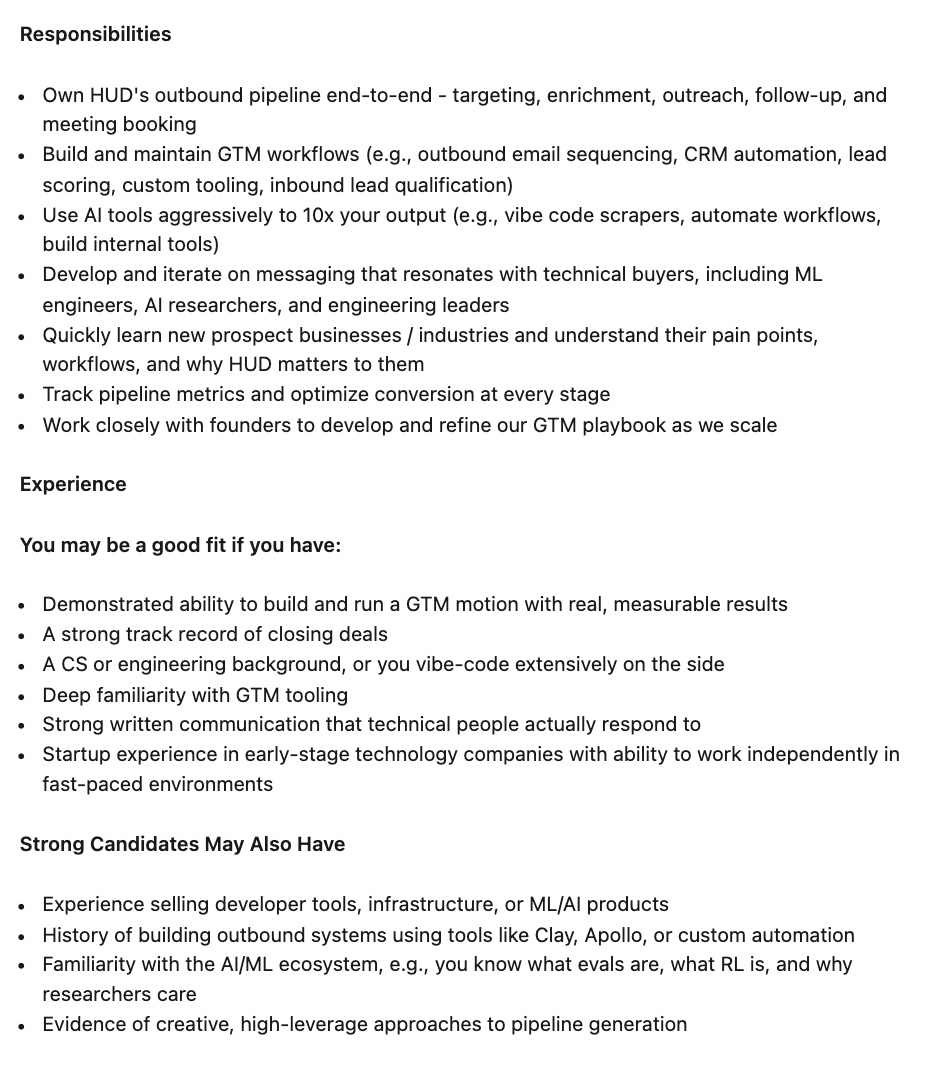
At another, the same title belongs to someone closer to a data engineer, owning ETL pipelines and the warehouse models that feed the entire revenue stack.
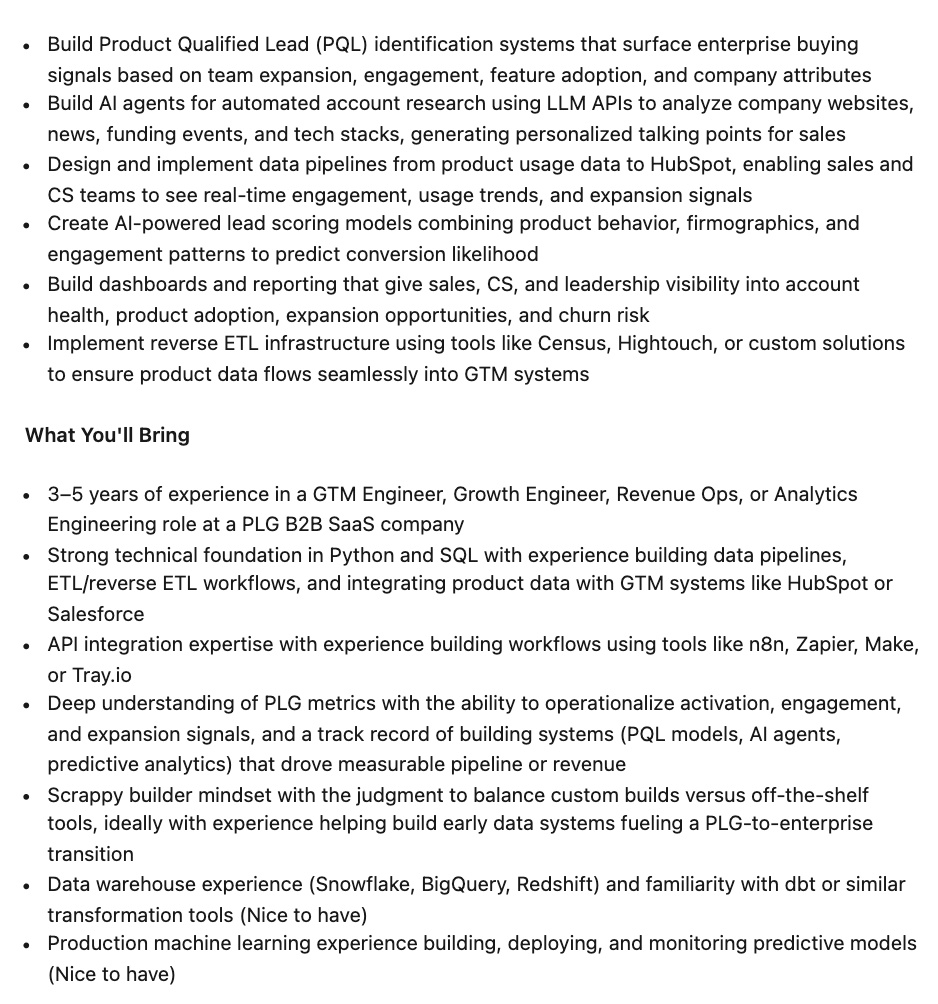
A third treats the role as a RevOps lead who happens to ship working prototypes every week. At ElevenLabs, the first GTM hire pitched rebuilding the revenue team around specialized agents in January 2024, long before that was a category anyone was hiring for, and the company has since scaled past $330M ARR running an AI SDR, an AI coach, and an AI CSM trained on one top human CSM's Gong calls.
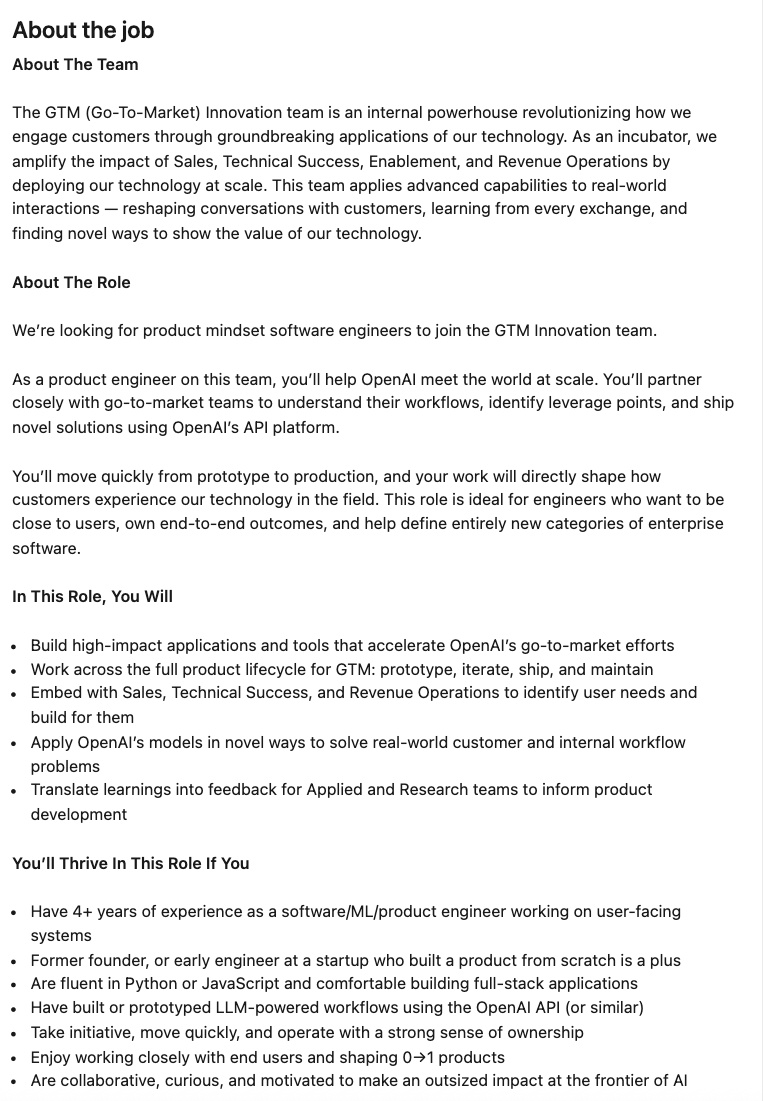
What ties the successful versions together is that someone is actually building. The best revenue leaders in the next wave will look less like the people-managers and quota-carriers of the last cycle and more like product engineers embedded inside a commercial org.
The executives who are pulling ahead are spending ten or more hours a week personally building agents and prompts, treating that as the price of staying current rather than something to delegate. The blunt version of this advice now circulating among SaaS founders: ship an agent yourself, or you'll be obsolete, and if you do, you'll be ahead of 98% of your colleagues.
So we looked closely at where these builders are coming from. We pulled GTM Engineering profiles off LinkedIn and classified every previous role they held, every job, every company, every title, all to map the feeder funnel for this emerging discipline.
Previous Background
We collaborated with Workforce AI to explore profiles whose current title contained any GTM-related keyword. We hand-curated a title whitelist, dropping pre-sales solutions architects, agency leadership, generic strategy and enablement titles, and Salesforce admins working on tooling rather than GTM motions.
About 65% of profiles had a previous role we could confidently classify. The rest had no previous title on LinkedIn or one too generic to place ("Member", "Senior Manager", "Project Manager").
With classified backgrounds:
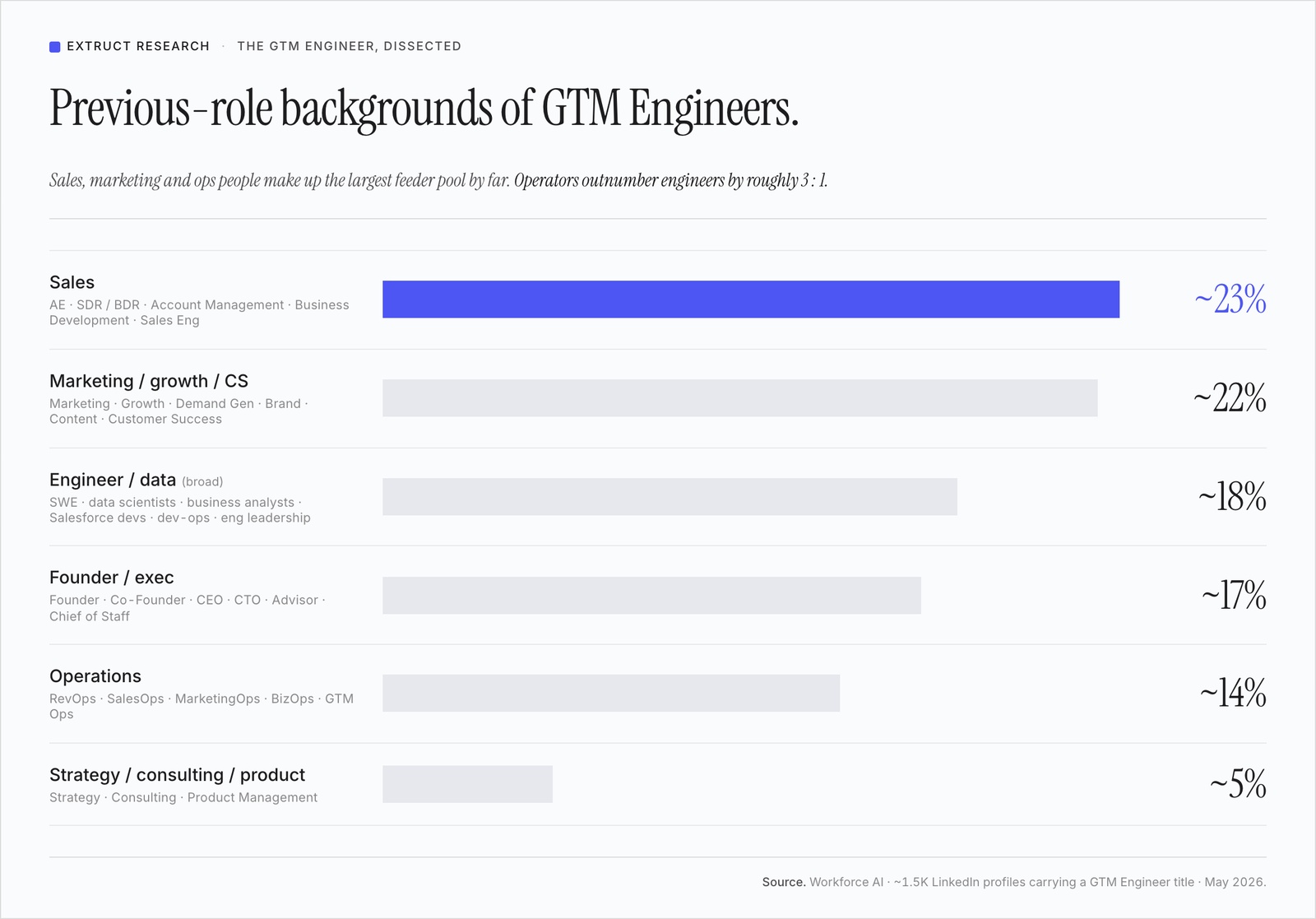
The most interesting thing in the data is what isn't there: a single, dominant route in. People arrive from four or five roughly comparable backgrounds, none cracking a quarter on its own, so no single path owns the title. That spread is what makes the role feel like a real movement rather than a rebranded job. It pulls in operators from the trenches of sales, people who came up running operations, and people from a completely different world, mostly engineering, and lands them all in the same seat.
Sales and marketing sit nearest the top, nearly tied at roughly 23% and 22% of the people we could place. Sales, marketing, and ops people are probably the ones that lean most on Clay and AI agent builders rather than raw code, but they bring the domain knowledge.
People with an engineering background are about 18% of that same classified group: software, data, and ML engineers, DevOps generalists, Salesforce admins, and engineering leaders who moved into GTM. The "engineer" in GTM Engineer is mostly metaphorical, but the direction is clear: operators are getting more technical and building their own tooling. That engineering group is mostly builders at heart, bringing to GTM the things they got used to in their previous roles: data pipelines, testing frameworks, deployment, and so on.
Dedicated operations people (RevOps, SalesOps, MarketingOps) are a smaller and cleaner group than you'd expect, about 14%: the systems-and-process folks who were already wiring tools together before the title existed.
Also, what caught my attention was that roughly 7% of all ~1,200 profiles had a Founder, Co-Founder, CEO, or CTO title in their previous role. (The chart's Founder/exec bar reads 17% because that bucket is broader and counts only the classified profiles.) I think we will see the trend accelerate: the future of revenue leadership belongs to builders.
Career stage
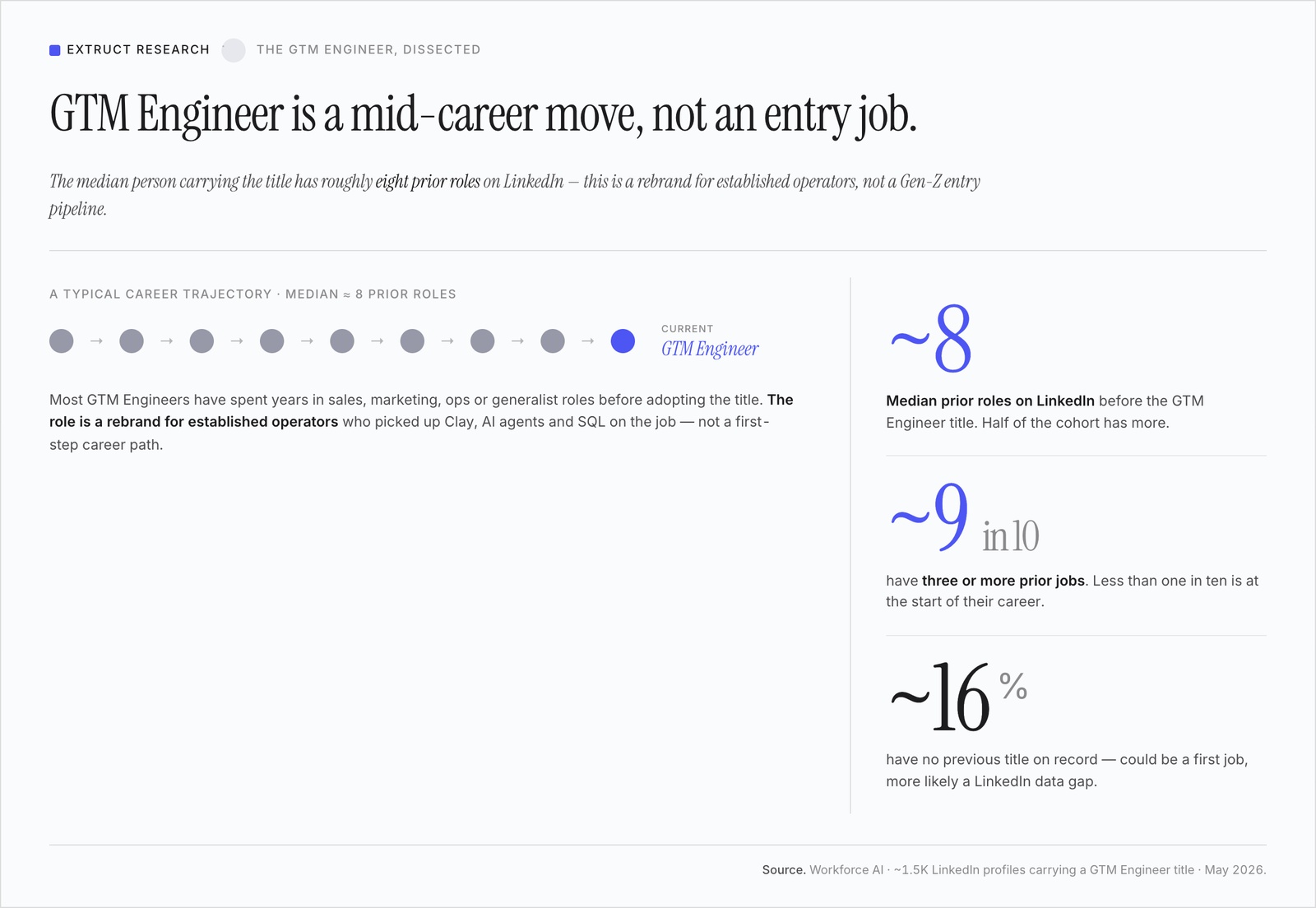
For 16% of profiles, there's no previous title on record (could be first-job, could be LinkedIn data gaps). But the broader picture: 91% have 3+ prior jobs, with a median of 8.
91% of the companies with a GTM Engineer have just one, though about a quarter of GTM Engineers themselves work somewhere with two or more. The companies with multiple GTMEs are mostly the AI-native poster children (Clay, Apollo, AirOps, OpenAI, Instantly) plus a small set of enterprise SaaS with internal GTM analytics teams (Adobe, LinkedIn, Klaviyo, Vercel).
The clear outlier there is Clay, which employs more than 40 people with the GTM Engineer title.
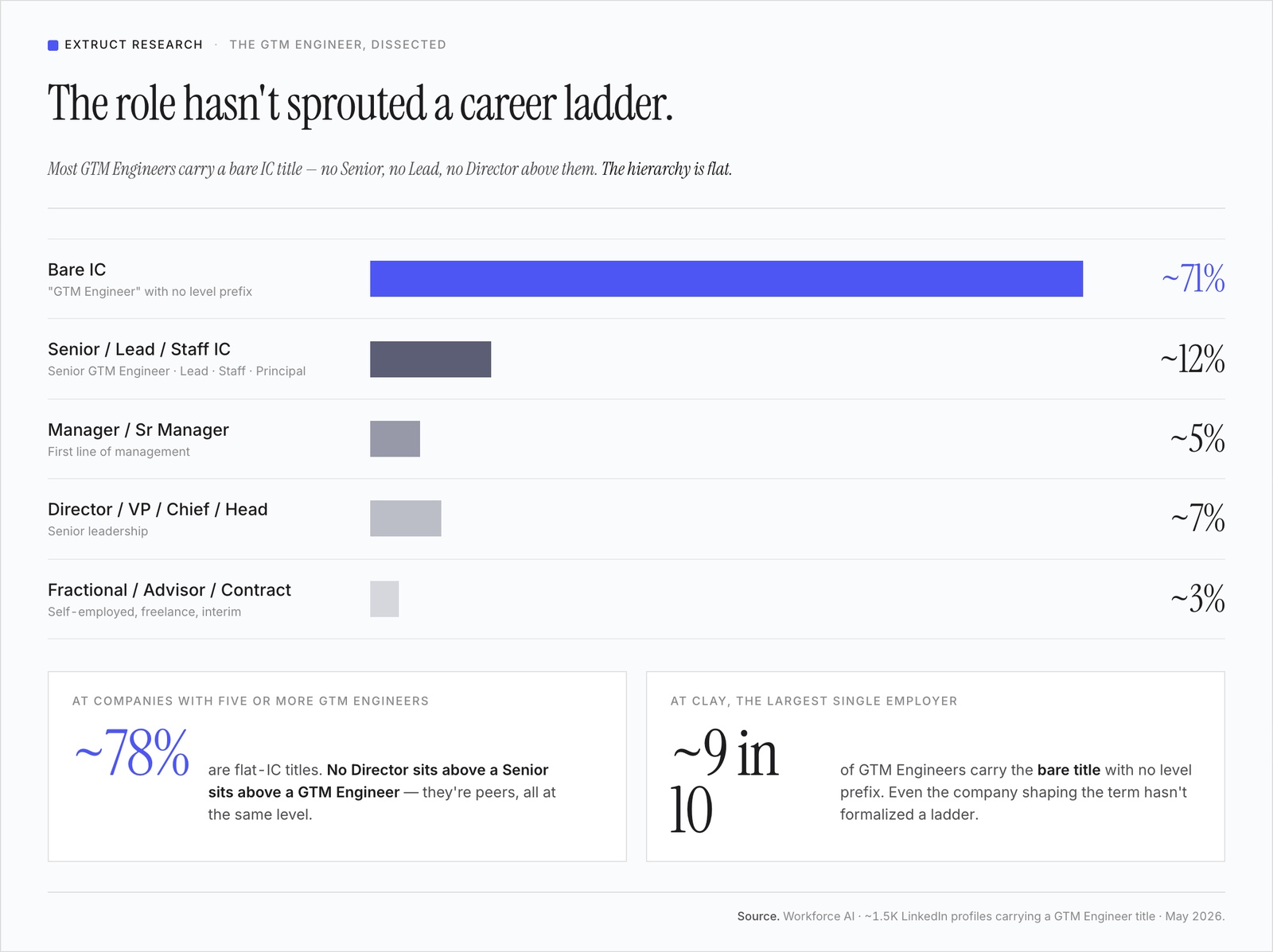
The role hasn't crystallized into a career track yet. There's no Director of GTM Engineering above a Senior GTM Engineer above a GTM Engineer at most companies. Among GTM Engineers at companies with more than one, ~90% hold IC titles; only ~2% carry a manager title and ~6% a director, VP, or chief.
Geography
Most GTM Engineers are in the US (44.4%), which isn't a surprise. The interesting one is India: almost 1 in every 10 GTM Engineers (9.4%) in the cohort is in India. The UK, Canada, France, Germany, and Brazil follow with single-digit shares.
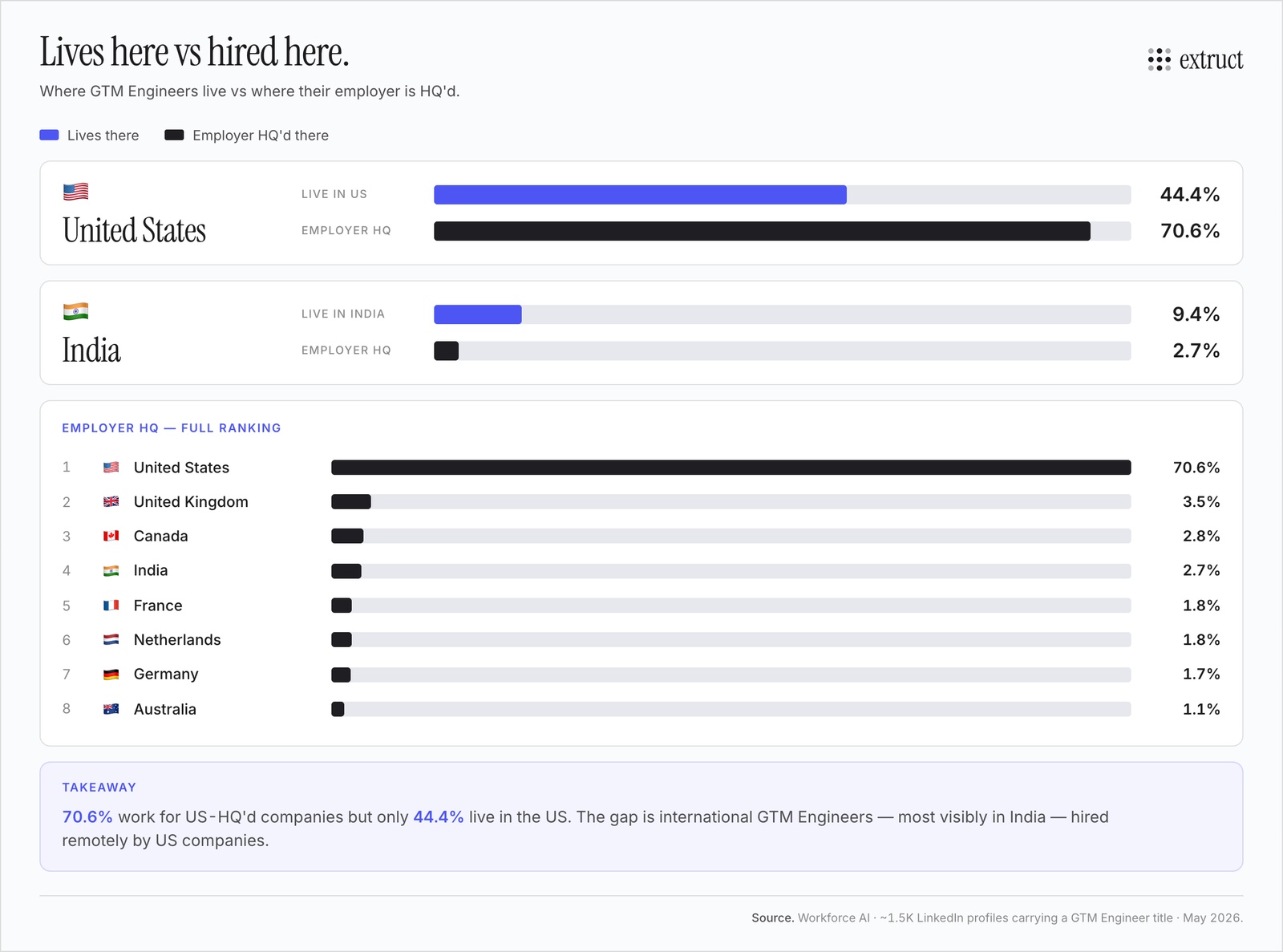
The employer side is much more US-concentrated. 70.6% of GTMEs work for US-headquartered companies, vs 44.4% who live in the US. The gap is explained by international GTM Engineers (especially the India 9.4%) hired remotely by US companies.
The company-size spread is remarkably even: 35.8% of GTMEs sit at small SaaS (11-200), 23.4% at growth-stage (201-1000), and 32.5% at enterprise (1001+). This isn't just an AI-native-startup phenomenon. About a third of GTM Engineers work at companies with more than a thousand employees, well past the startup phase.
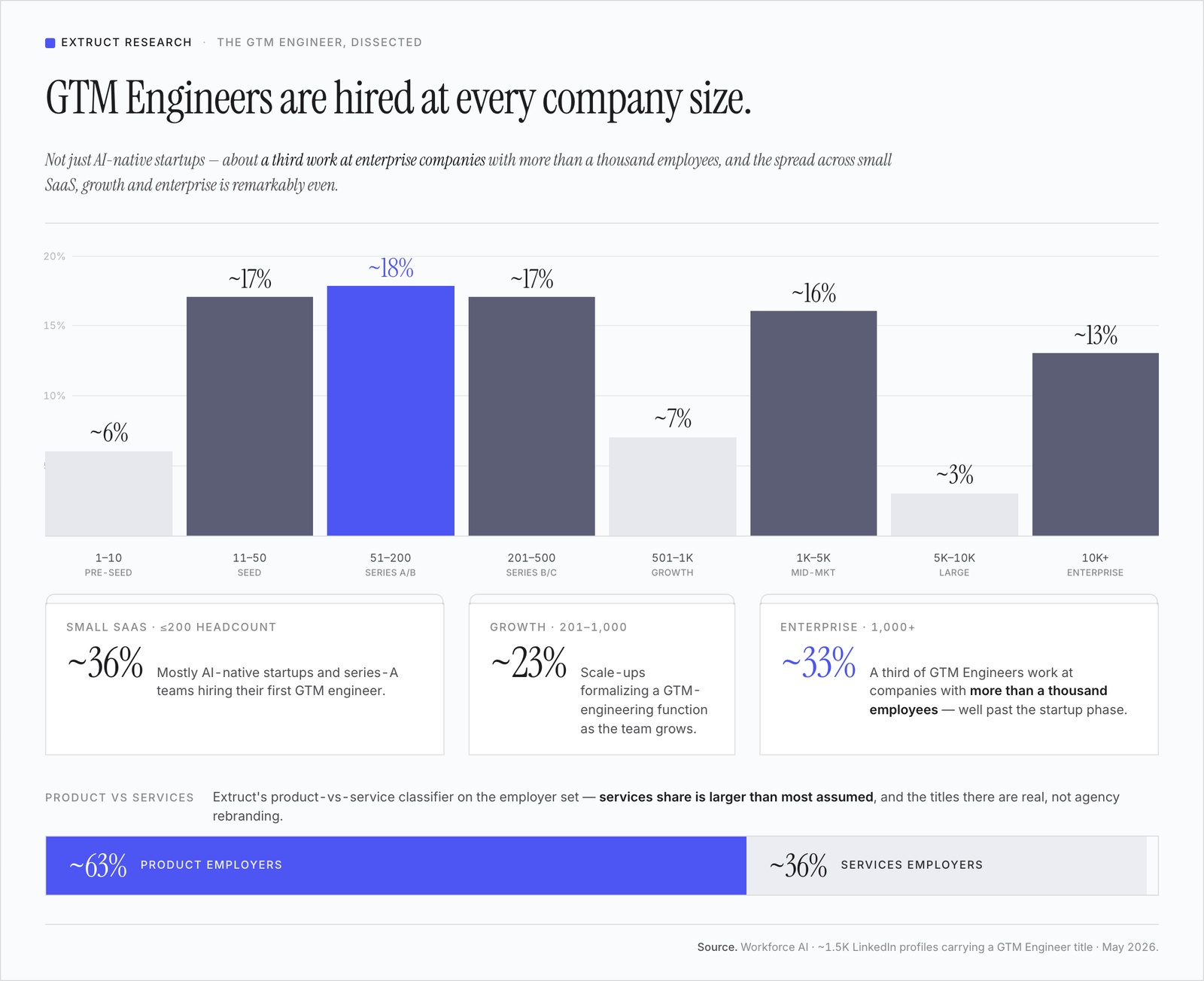
The "GTM Engineering as a service" mode is small. Only ~3-5% are explicitly fractional. The real population is in-house, which makes sense given how hands-on the work is.
The GTM Engineer role is still early. It attracts curious, technical profiles, and companies are still figuring out exactly who they need. There are no senior leaders in this market yet, so we're at the stage where curiosity and a builder mindset outpace domain knowledge.
The right profile also varies from one company to the next. Some roles suit a more engineering or analytical person; others are better filled by someone who came up in sales or as an account executive and already knows the motion. Personally, I think the strongest fit is a founder or founding-GTM type with some technical background: someone who can build, but also understands the commercial side.
Methodology
We collaborated with Workforce AI to analyze roughly 1,200 LinkedIn profiles carrying a GTM Engineer title as of May 2026. Workforce AI captures near-real-time data on US employment changes, monitoring 1M+ job changes and 300M+ employment validations monthly across companies, roles, functions, levels, industries, and locations.
Workforce AI normally sells this data to platforms that incorporate people data, such as sales tech, CRMs, talent platforms, private wealth, HR teams, and investors like VCs, private equity, quant funds, etc. It also serves as a data resource for well-known media outlets, including the Wall Street Journal, The Economist, The Information, and Bloomberg. If you have questions about their data, please ping Scott. And you can also install their free Claude MCP as a custom connector (mcp.workforce.ai).