 Danny Chepenko
In 2023 I was tasked to help InDrive (2nd most downloaded ride-hailing app) to set up corporate venture arm. We invested across frontier markets.
Try mapping logistics startups in Pakistan or Egypt using off‑the‑shelf databases and you quickly hit the limits: partial coverage, stale records, and rebrands that fell through the cracks. We'd see three different versions of the same company, miss a quiet pivot, or chase a funding round that never made it into the feeds. That gap—coverage, freshness, identity—kept showing up in the work, not in the slideware. That's the pain that pushed me to join Extruct.
To keep pace, we built our own data solution and turned to web scraping: public registries, funding announcements, LinkedIn/X graphs, hiring pages, job postings, and app store marketplaces. It delivered volume, not judgment; unknown unknowns stayed unknown, and analysts drowned in lists.
Then in 2024, deep‑research agents became practical. They didn't make databases obsolete overnight, but they offered a way to mitigate the biggest issues we kept hitting: data freshness, limited source breadth, and messy identities across systems. That opened a better path for market research—keep the volume tools for what they're great at, and layer structured agents on top when you need depth, recall, and judgment.

What changed: from generic chatbots to vertical deep research
General‑purpose LLM chatbots are impressive, but they assume you already know how to ask and what "good" looks like. In practice, investors need structure more than open‑ended chat.
Extruct AI tackles research through a "problem structure" lens: understanding that each company is an independent unit of investigation, and that each research question is distinct. It presents the research as a table—rows as companies, columns as questions—where every cell is handled by its own dedicated AI agent instance. This architecture means the research process leverages a much larger effective context window (thanks to many parallel agents with their own memory and tool calls), enabling deeper dives and more robust outputs per company and question.
Traditional approaches might sequentially process reports, but Extruct's setup allows you to treat each company systematically and independently, with each agent specializing in a unique slice of the research. This makes it much easier to revisit the table and add new columns or data points later on, without redoing the initial groundwork. The result: richer context, higher consistency, stronger recall, and insights that improve the more you ask.
Why classic startup databases aren't the full answer
Databases like Crunchbase, PitchBook, Dealroom, CB Insights, and Harmonic are valuable—especially for volume tasks. But they're incomplete for frontier coverage and for questions that require nuance.
- Coverage gaps: non‑US, non‑English sources lag; pivots and rebrands are easy to miss.
- Freshness issues: batch pipelines plus news‑only sourcing means out‑of‑date profiles.
- Identity drift: no universal "ticker" in private markets; the same company appears differently across providers and CRMs.
- Schema limits: your thesis often needs attributes the vendor doesn't track.
Your deal flow doesn't start or end in a database anyway. The real funnel is broader:
- Referrals (partners, founders, LPs)
- Inbound (website, events, content)
- Partnerships (accelerators, corporates, scouts)
- Your own research (open web, social, papers, GitHub, registries)
- CRM exhaust (emails, meetings, intros)
The job is to unify those streams, not to pretend one vendor can replace them.
Where the volume approach is still the right tool
There are jobs where a database is the fastest and cheapest option:
- Broadcasting: invite every startup from Central Asia to your incubator event.
- Coarse filtering: Series A companies in MENA with 20–100 employees.
- Top‑of‑funnel enrichment: add basic fields before outreach.
Could Extruct do these? Yes, but it's slower and costlier per unit because each lookup is a "column" in a deep table. Use volume tools for volume work.
💡 Note: For broad counts, generic filtering, or geo‑stage slices, a database wins on cost and speed. Save Extruct for precision work where accuracy matters.
Where Extruct is better: precision and depth
Use Extruct when you need structured judgment, not just rows:
-
You already know the niche and want to map it precisely.
-
You want to close recall gaps after you've exhausted database search—"What did we miss?"
-
You have sharp criteria, e.g., "Private digital payment processors serving the legal cannabis industry that enable compliant, auditable cash‑to‑digital payments in regulated EU markets."
-
You're enriching known companies with hard‑to‑model attributes: supplier concentration risk, manufacturing complexity, regulatory exposure, founder credibility signals.
-
You need one search across all your mediums—email, CRM notes, PDFs, vendor databases, and the open web—with de‑duplicated, normalized, rankable results tied to the same company/person IDs.
Because research is a table, you can add columns—"Manufacturing complexity" or "Go‑to‑market motion"—without rerunning everything.
And because those questions cross systems, Extruct doesn't just "chat"; it retrieves across your stack and returns structured answers mapped to your schema. That's why the next step isn't another tool, but an intelligence system that handles normalization and entity resolution.
From tools to an intelligence system
Two foundational capabilities make the intelligence system useful:
- Data normalization: consistent schemas for companies, people, and deals; source precedence rules; hierarchical measurements.
- Entity resolution: deciding that "Company A" in PitchBook, "A Ltd." in Harmonic, and "A, Inc." in your CRM are the same entity.
Extruct provides this middle layer so your LLM can answer precise, personalized questions across your mediums—email, CRMs, databases, LinkedIn—on top of clean, connected data. Private markets have no ticker symbols, CUSIPs, or ISINs. Your providers don't agree on identities, and many CRMs use email addresses as primary keys. That's how the same founder spreads across four records.
Think less "one more app" and more MCP server—a modular backend that integrates:
- Memory: persistent data on startups, people, markets, theses (structured + unstructured).
- Context: links across entities—who introduced whom, when you last talked, how two companies compare.
- Persona: your investment lens, preferred taxonomy, writing style, and workflows.
Do you need Extruct?
Start with the firm, not the tool:
- Clarify strengths/weaknesses: what works today, what consistently breaks?
- Set a north star: more coverage, or better prioritization and access?
- Map deal flow: referrals, inbound, partnerships, own research—where does truth live, and where does it get lost?
Then choose the simplest thing that works:
- If you mostly need more top‑of‑funnel, get the database and wire up outreach.
- If you need sharper picks and reusable knowledge, stand up Extruct for depth.
- If you need both, combine them: use databases for volume and Extruct to validate, enrich, and rank.
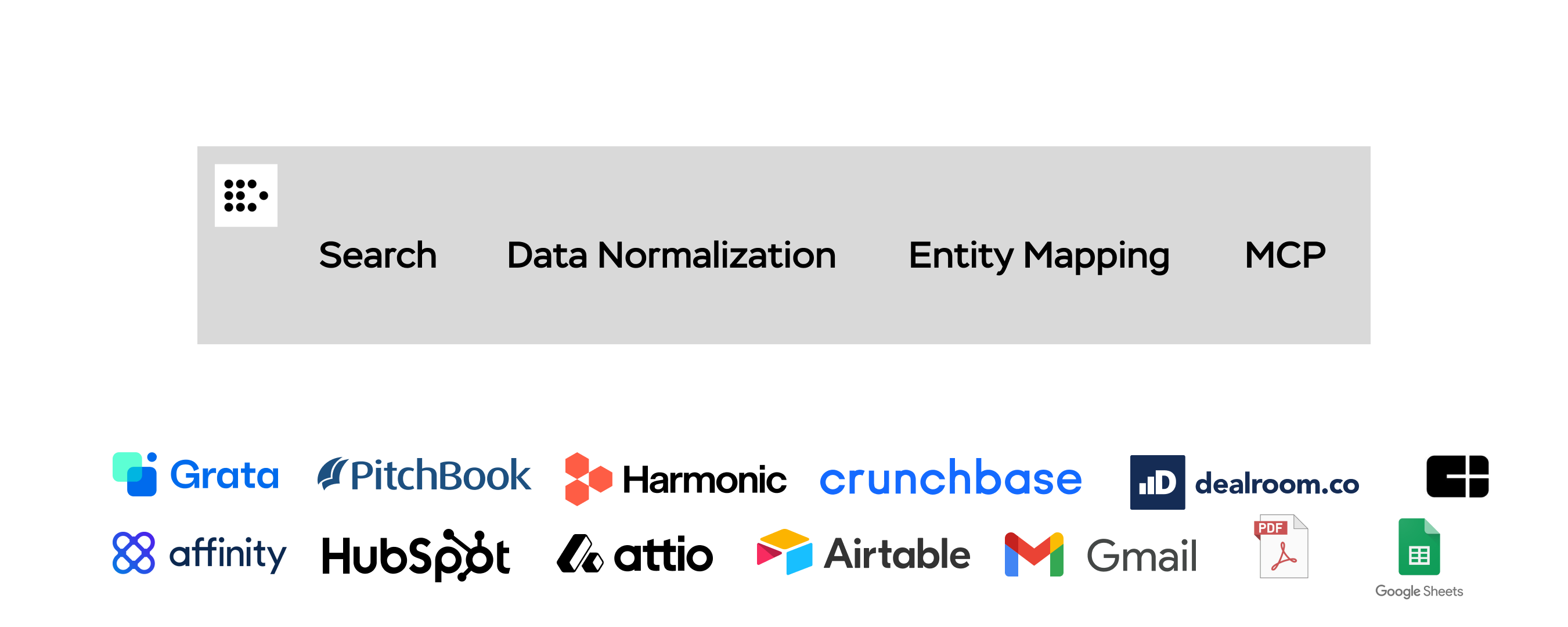
Where we fit today
Extruct is an intelligence layer with a deal‑origination function—not the other way around. We minimize manual CRM entry, unify your sources, and let you ask hard, specific questions with confidence.
