 Danny Chepenko
Hey, Danny here.
Over the last few weeks I've been deep into Claude Code, and I'm confident it's the most powerful tool for GTM I've used. Not because of what it can do out of the box — but because of what happens when you teach it how you work.
Claude Code is Anthropic's agentic coding tool. It started as a CLI that runs in your terminal, but now it's also available as a standalone desktop app and inside IDEs. You give it a task, and it actually executes it: writes scripts, calls APIs, scrapes websites, processes files, creates spreadsheets. It's not a chatbot you copy-paste from. It does things directly on your machine.
Anthropic also recently launched Cowork — a separate product that brings the same agentic architecture to the Claude Desktop app, but for non-coding knowledge work. No terminal required. It runs locally in an isolated VM, takes on multi-step tasks, and loops you in before taking significant actions. "Cowork is less a new feature than it is a new way of working." If you've used Claude Code for GTM and wondered what it would look like without the command line — that's where Cowork is heading.
It comes with built-in tools — read files, write files, run shell commands, search your codebase. But you can also connect external services: CRMs, enrichment APIs, email sequencers, research tools. Claude Code calls them the same way it calls anything else — you describe what you need, it figures out which tool to use.
The full skills repo is open source — github.com/extruct-ai/gtm-skills. Everything described below is in there.
But here's the thing: tools alone aren't enough.
Skills: Your Methodology, Packaged
A Skill is a set of instructions — written in plain English, stored as a Markdown file — that teaches Claude Code how to approach an entire category of work. Not what to do in a single moment, but how to think about a type of task.
Skills aren't code, but playbooks. If you can describe how you do your job in a structured document, you can create a Skill.
The GTM Skills Pipeline
Here's the full set of skills I run today, organized by pipeline stage. Each one reads from the previous step's output. The whole thing chains together.
What makes this interesting for GTM: Claude Code doesn't ship with campaign management or outbound workflows. But because it reads and writes files on your machine — and because you can teach it how to do things through skills — you can build an entire outbound pipeline on top of it. Your ICP definitions, hypothesis sets, enrichment configs, email templates, campaign results — they're all just files on disk. Skills read from them, write to them, and chain together.
Context & Research
/company-context-builder
Everything starts here. We start by building a context repository of markdown files that capture everything about your company: products, personas, competitive positioning, voice and tone. Instead of copy-pasting the same company context into ChatGPT every time you start a new session, you save it once as files and tell Claude Code to read them. The context persists across sessions. It compounds.
One markdown file per company that captures product info, ICP, voice rules, win cases, proof points, campaign history, and DNC lists. Every other skill reads from this file.
Four modes: create a new context, update an existing one, extract signals from a call recording, or import campaign results back in.
> Build a company context for Extruct. Here's our landing page: extruct.ai
/hypothesis-building
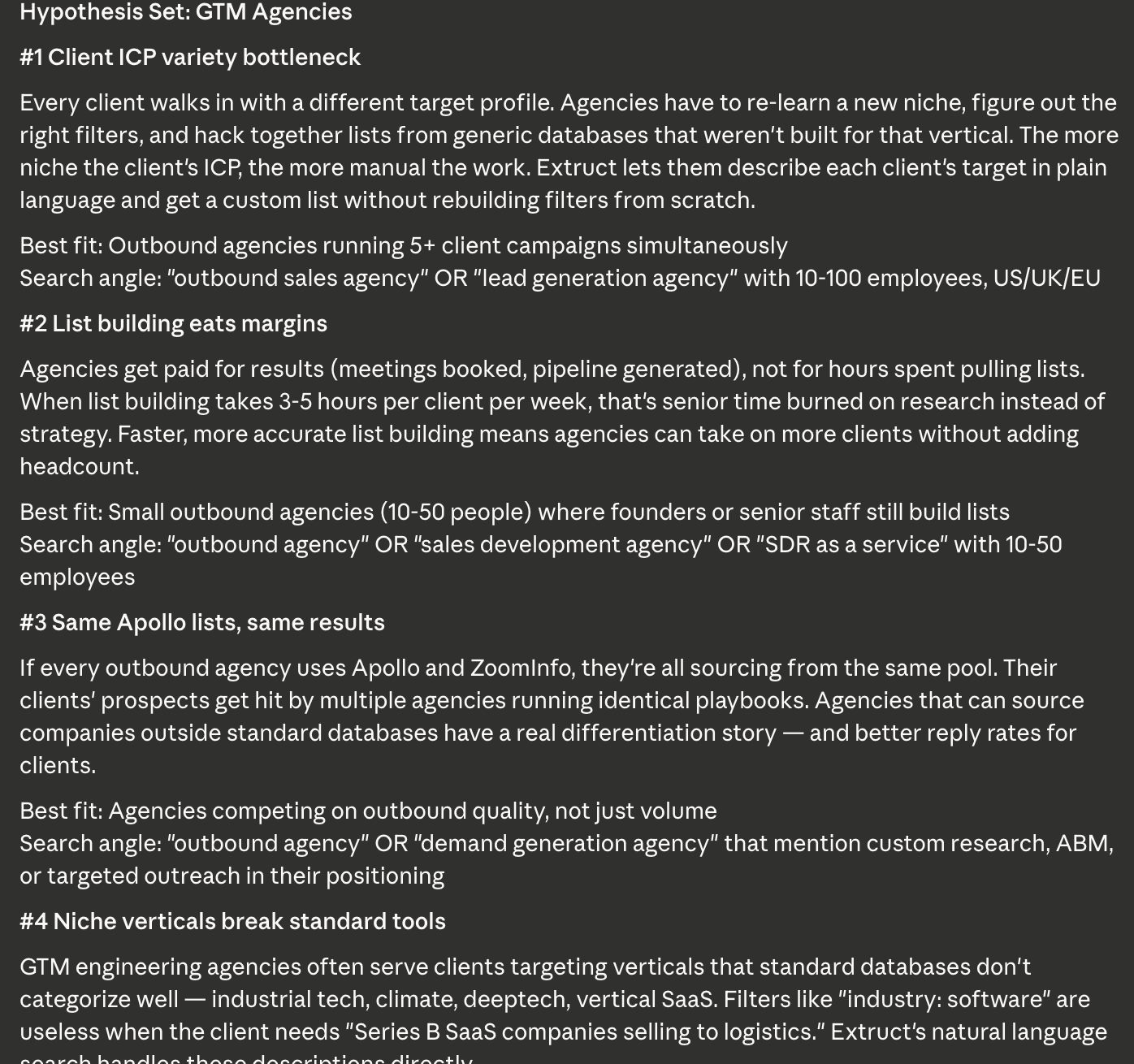
Generate testable pain hypotheses from your context file. No API keys needed — pure reasoning. It reads your ICP, win cases, and product knowledge, then outputs a hypothesis set with search angles that directly guide list building.
> Help me create hypotheses for selling to GTM agencies — outbound agencies,
  GTM engineering shops, and others.
/market-problems-deep-research
When hypotheses aren't enough and you need real industry education. Uses the Perplexity API to research a vertical's pain points, then distills findings into a numbered hypothesis set. Pure research — decoupled from email generation.
> Research pain points in the search fund vertical. What are they struggling
  with in deal sourcing?
List Building & Enrichment
/list-building
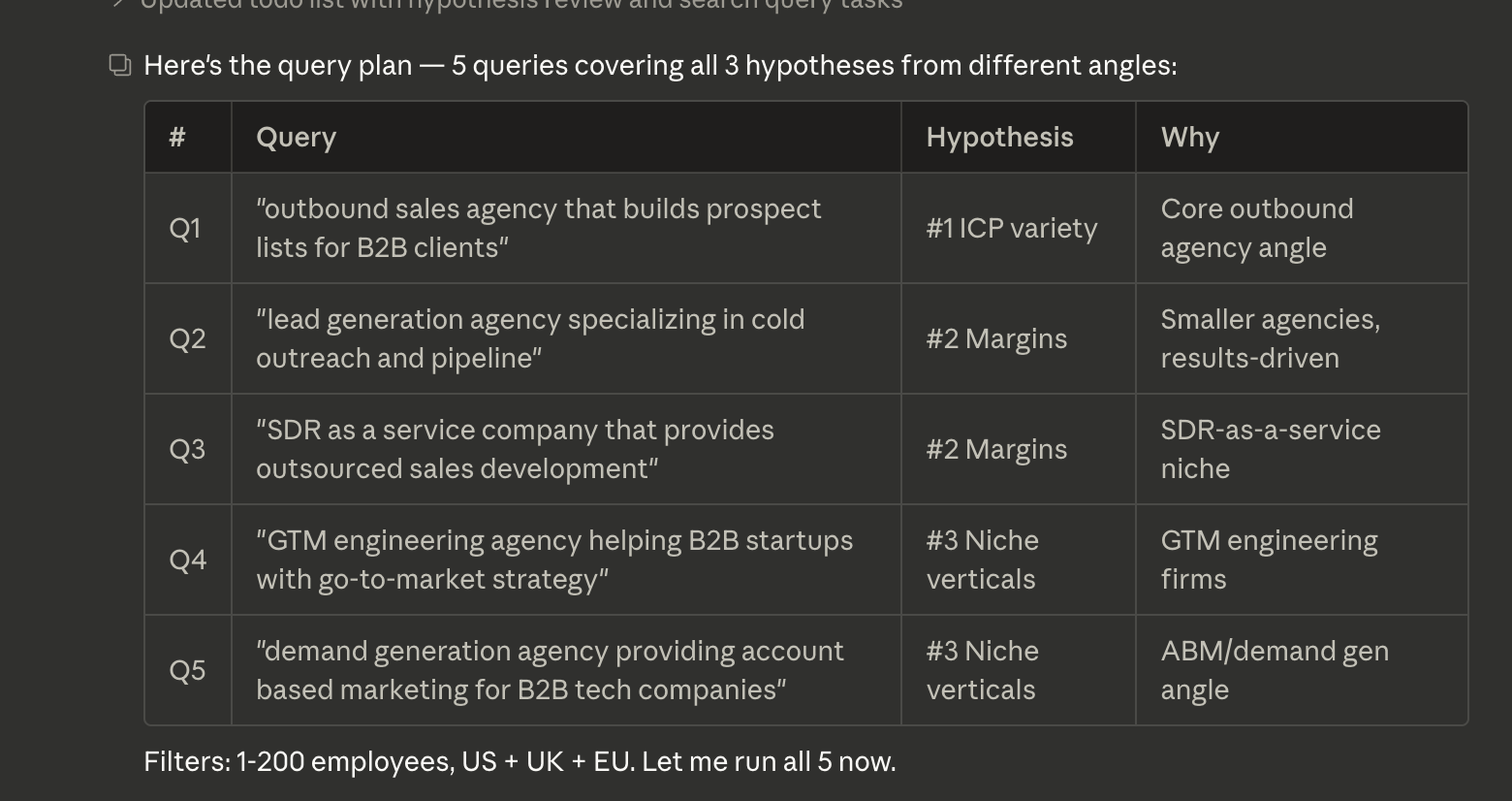
Build company lists using the Extruct API. Three methods based on a decision tree: lookalike search (you have a seed company from a win case), semantic search (broad description), or deep discovery (qualified, criteria-scored results). 200-500 companies in seconds.
> Find 200 companies similar to True Capital. Focus on mid-market VC firms
  with 50-200 portfolio companies.
/create-table
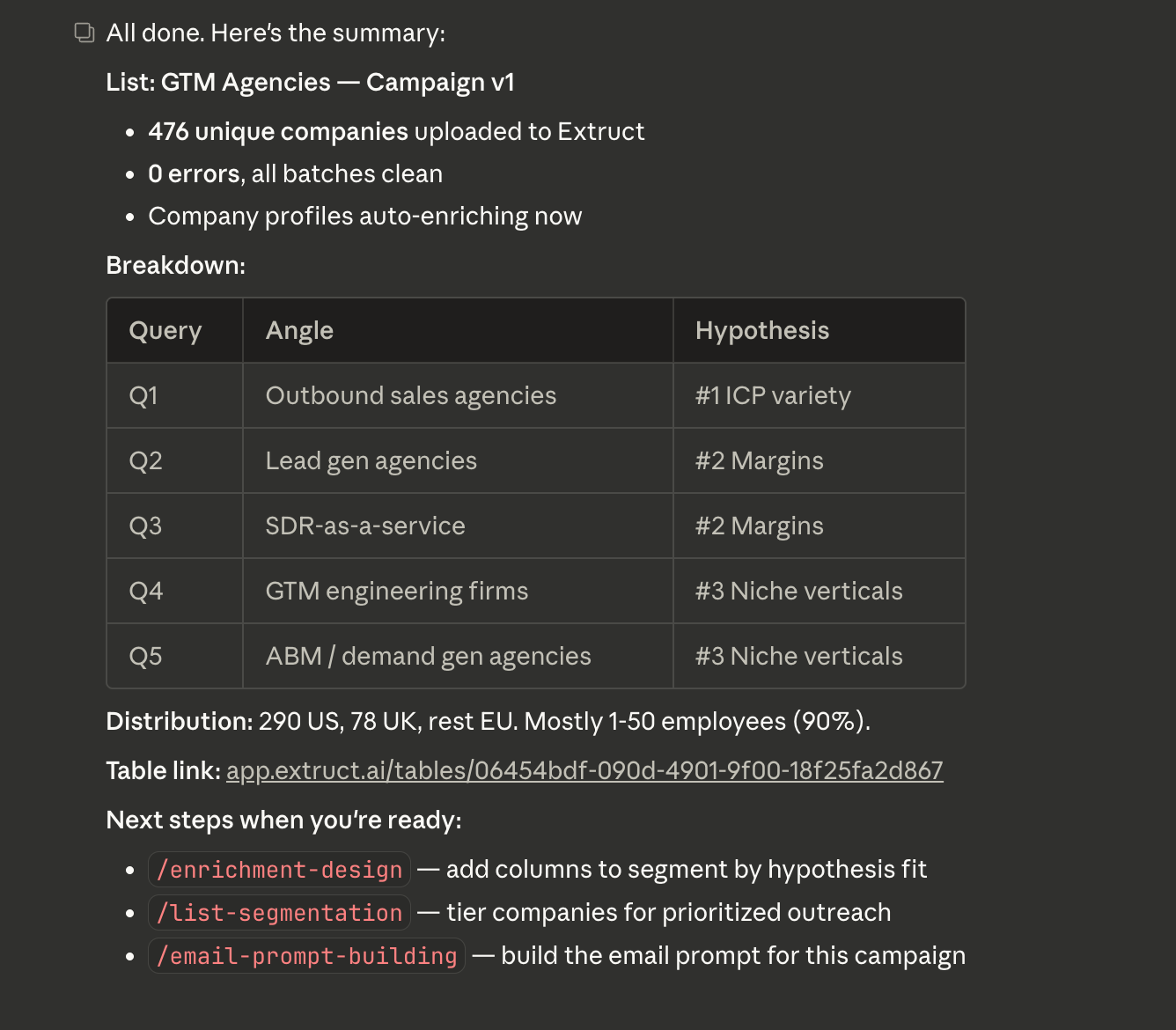
Upload companies to an Extruct table. Handles the full flow: parse input (CSV, pasted list, or structured data), create or reuse a table, upload domains in batches, add columns, trigger enrichment.
> Create a new Extruct table called "GTM Agencies Q1" and upload this CSV.
/data-points-builder
Bridge the gap between your hypotheses and actual enrichment. Two modes: segmentation columns (score hypothesis fit per company) and personalization columns (company-specific hooks for emails). You design the columns interactively, then hand them off to table enrichment.
> Based on our hypothesis set, what data points should we research about
  each company? I need both segmentation and personalization columns.
/table-enrichment
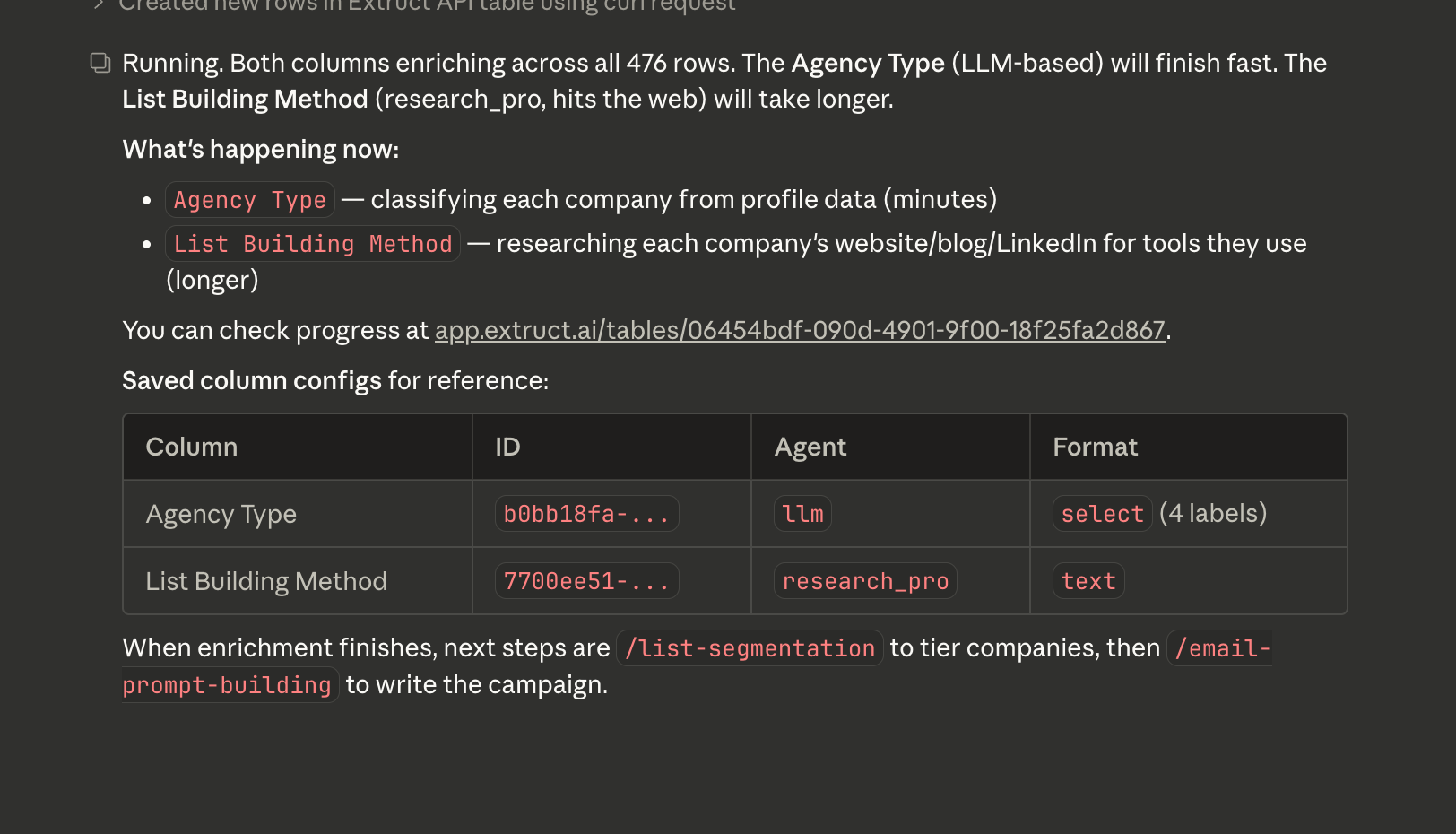
Run enrichment columns on your Extruct table via the API. Takes the column configs from data-points-builder and executes them — funding data, vertical classification, tech stack, whatever you designed. Monitors progress and lets you review results.
> Enrich table "GTM Agencies Q1" with the columns we just designed.
/segment-and-tier
Take the enriched table and your hypothesis set, then segment companies by hypothesis fit and assign tiers based on data richness and signal strength. Tier 1 gets individual attention. Tier 2 gets templates. Tier 3 gets deprioritized.
> Segment and tier the GTM Agencies table against our hypothesis set.
People & Contact
/linkedin-finder
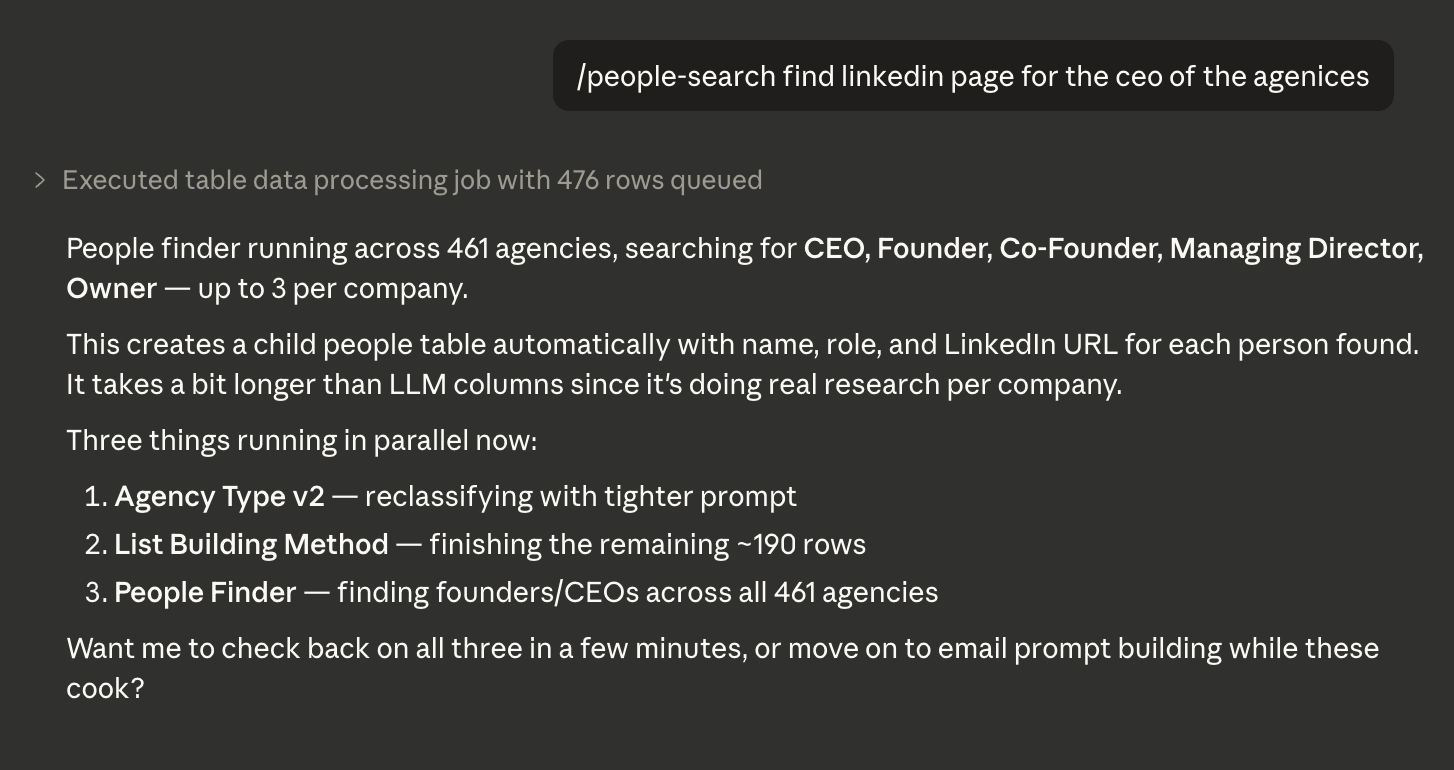
Find decision makers at target companies using Extruct's people index. Takes a company table, adds a people finder column, and produces a linked child table with names, roles, and LinkedIn URLs. No external API credits — it's built into Extruct.
> Find Heads of Growth and VP Sales at the Tier 1 companies.
/email-finder
Get verified emails and phones for the contacts from linkedin-finder. Runs profiles through Prospeo and/or Fullenrich. Supports single-provider and waterfall modes. Outputs a contact CSV ready for email generation.
> Get verified emails for all the contacts we found. Use waterfall mode.
/find-people
Combined workflow — people search + email enrichment in one step. Takes a company list, generates relevant job titles, searches via Prospeo, enriches with verified emails and phones. Use this when you want to skip the two-step linkedin-finder + email-finder flow.
> Find VP-level contacts at these 50 companies and get their emails.
Email & Sending
/cold-email
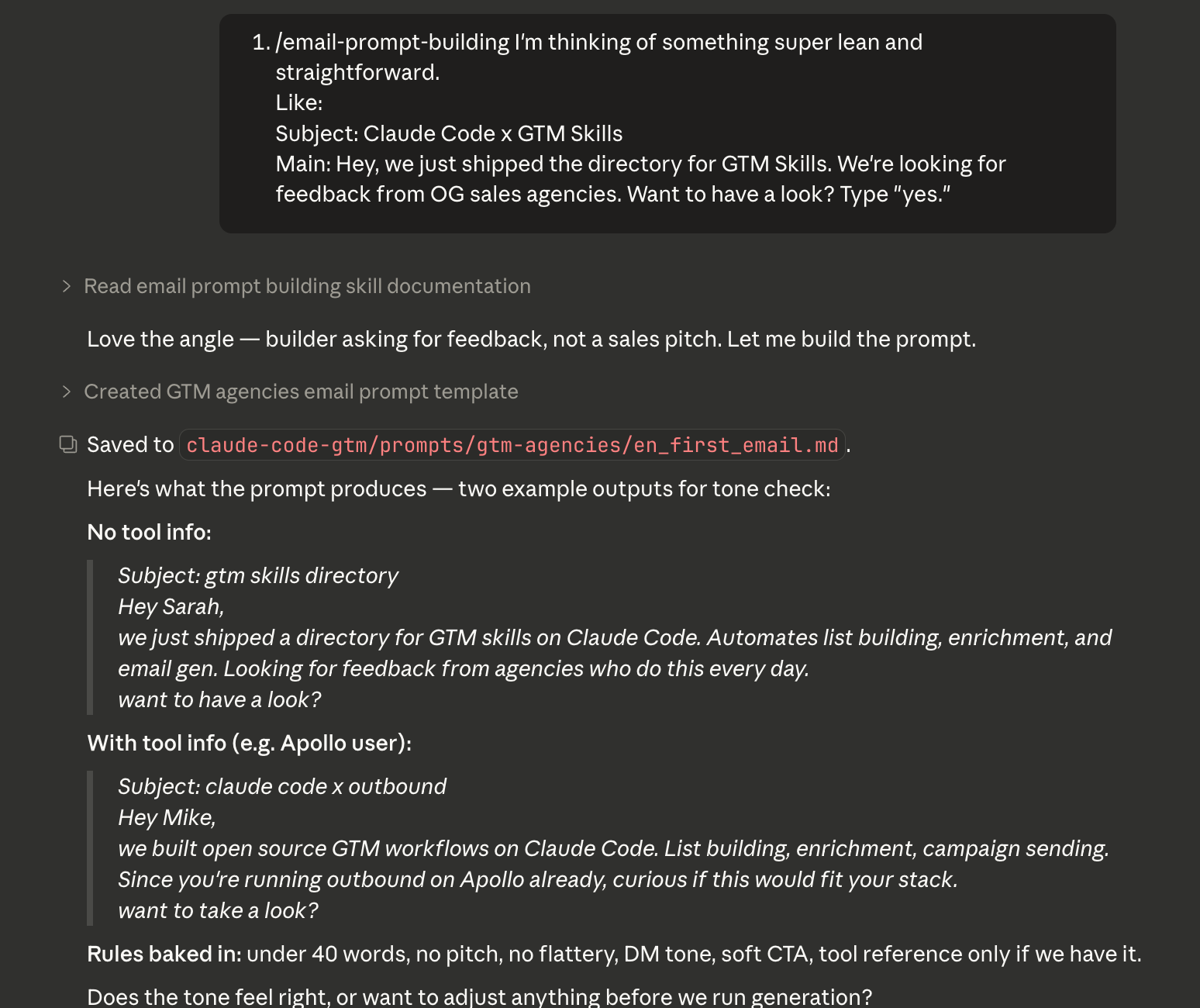
Build a self-contained email prompt template for a campaign. Reads your context file (voice, value prop, proof points) and campaign research (hypotheses, data points), then synthesizes everything into a single prompt. One prompt per campaign. All the reasoning happens here — the email generator just runs it.
> Build an email prompt for the GTM agencies campaign. Use the hypothesis
  set and segmentation data we have.
/email-generation
Run the prompt template against your contact CSV. This skill is a runner, not a reasoner — all strategic decisions were made by cold-email at build time. It generates one email per row, personalized using the enrichment columns and contact data.
> Generate emails for the Tier 1 GTM agencies contacts using the prompt
  we just built.
/copy-feedback
Simulate a skeptical buyer reading your cold email. Builds a full prospect "world" from their LinkedIn and company data, defines their professional reality (KPIs, pain points, inbox behavior), then runs a roast — emotional reaction first, business evaluation second. One prospect at a time, Tier 1 only.
> Review the email for Sarah Chen at Belkins. Would she actually reply?
/run-instantly
Last mile. Upload finalized emails to Instantly for sequencing and sending. Maps fields to Instantly's lead schema, creates or finds campaigns, uploads leads with dedup, and gives you a pre-send verification checklist. I always manually verify before hitting send.
> Upload the Tier 1 emails to Instantly. Campaign name: "GTM Agencies - March"
The Feedback Loop
After a campaign runs, results feed back into /company-context-builder. What worked, what didn't, which hypotheses converted — all of it goes back into the context file. Next campaign starts smarter than the last one.
This is the part most GTM teams miss. They start fresh every campaign, losing context across tools and people. With skills, every session builds on the previous one. The knowledge compounds.
How It All Connects
Skills communicate through markdown files. The company context file is the spine — every skill reads from it. Hypothesis sets flow from research into data-points-builder into enrichment. Prompt templates flow from cold-email into email-generation. Each file is human-readable, so you can inspect and edit any step.
context file
  -> hypothesis-building
    -> list-building + create-table
      -> data-points-builder + table-enrichment
        -> segment-and-tier
          -> linkedin-finder + email-finder
            -> cold-email + email-generation
              -> copy-feedback
                -> run-instantly
                  -> context file (feedback loop)
Claude Code connects to external services through API keys and MCP servers — Extruct for company data, Perplexity for research, Prospeo and Fullenrich for contact enrichment, Instantly for sending. You set the keys once and every skill that needs them picks them up automatically.
Getting Started
The full skills repo is open source:
github.com/extruct-ai/gtm-skills
Install via skills.sh CLI:
npx skills add extruct-ai/gtm-skills
Or via Claude Code's plugin manager:
/plugin marketplace add extruct-ai/gtm-skills
/plugin install gtm-skills
Skills install to ~/.claude/skills/ — install once, use across all your projects.
The only required credential is an Extruct API token (free trial with 100 credits at extruct.ai). Set it in your terminal:
export EXTRUCT_API_TOKEN=<your-token>
Skills that don't call the Extruct API — context-building, hypothesis-building, email-prompt-building, email-generation — work without it.
You don't need to follow a fixed sequence. Each skill works independently. But if you want a starting point, describe what you need and Claude will figure out the plan:
I'm building www.example.com.
One of my customers is www.customer.com,
they use us to score suppliers.
Find similar companies and plan a campaign.
This triggers plan mode — Claude will research, ask clarifying questions, and propose a step-by-step campaign before executing.
Resources
Useful repos and tools for your Claude Code setup:
- Anthropic Official Skills — Canonical skills from Anthropic (docx, pptx, xlsx, PDF creation, and more).
- Claude Code Guide (Cranot) — Most complete community reference. Auto-updates every 2 days. 2,360+ stars.
- Awesome Claude Code — The definitive community list. Slash commands, CLAUDE.md files, agents, skills, hooks, plugins.
- Skills.sh — Marketplace of 55,000+ installable skills. Search for marketing-relevant ones like copywriting, SEO audit, social content.
- AI Templates — Open-source library of 30+ pre-built Claude Code agents, skills, commands, hooks, and MCP configs.
- Marketing Skills (Corey Haines) — CRO, copywriting, SEO, analytics, email sequences, growth engineering skills.
- Context7 — MCP server that feeds Claude Code up-to-date documentation for any library or framework.
